Home » Articles posted by Zulkifli Musa (Page 4)
Author Archives: Zulkifli Musa
Call for Paper: Powerful and Powerless 13th Annual Conference of the European Association of Taiwan Studies (EATS), 2016
Deadline for submission of abstract: 15 September 2015.
The 13th EATS Conference will take place in Prague, Czech Republic, 30 March-1 April 2016. The main theme of the conference is Powerful and Powerless.
Power relationships, broadly understood, pervade society on many levels and in many guises. They may be explicit or implicit, acknowledged or hidden, based on outright coercion or, instead, on more subtle forms of coaxing, manipulation, and indoctrination. They can involve individuals as well as collectives. In different contexts such as faith, ethnicity, class, gender, and sexual orientation, they can render people susceptible to the effects of power in different ways.
We invite participants to engage with the phenomenon of power in their respective area of research, be it social sciences or in the humanities, and to focus on the relationship between those who wield power on the one hand and those who are affected by the decisions of the powerful on the other.
By investigating the strategies, conventions, and tensions underlying the interactions between the two sides, we hope the papers of this conference will offer novel insights into such issues as persistence and change in power relationships over time; the shifting positions and multiple roles individuals as well as groups can assume in different contexts and vis-à-vis different counterparts; the significance of symbolic representations of power; historical, moral, religious, and political justifications of inequality; strategies employed in contesting existing power relationships; formal and informal structures established with the purpose to create, enforce or perpetuate hierarchical relationships; the scope of individual and collective agency in the face of the limiting effects of power. In this way, we hope to expand our knowledge of powerful and powerless in Taiwan and to enrich the discipline of Taiwan Studies.
For submission, please send an abstract of 500 words, including 3–5 keywords in MS Word document, to the EATS website and send a copy to info@eats-taiwan.eu.
Submission will be open from 1 August to 15 September 2015. After a double blind review process, we will announce the successful submissions by 31 December 2015.
Postgraduate students who are affiliated with European institutions, as well as Europe-based post-doc researchers who have received their PhD no longer than three years, are strongly encouraged to take part in the contest of Young Scholar Award (YSA). The winners of YSA will receive a modest monetary reward. If interested, please specify your participation in the YSA contest in your submission with a statement of your status (MA, PhD or post-doctoral). Further details of YSA will be announced in due course.
To nurture junior researchers at their formative stage, EATS will organize a MA panel for students to practice their presentation skills and to receive critical feedback. The MA panel is not confined by the theme of the conference, although it should be relevant to the broadly defined field of Taiwan Studies. For the submission to the MA panel, please write an abstract of 300 words on a topic of your choice.
Accepted postgraduate presenters (PhD and MA students) who are affiliated with European institutions will receive a travel grant of €150.

PhD position in Non-European and Global History (4 years, full time, i.e. 30 hours), focus Asian Maritime History
PhD position in Non-European and Global History (4 years, full time, i.e. 30 hours), focus Asian Maritime History.
Start: 01.10.2015
End: 30.09.2019
Duties and functions:
Scientific support in research and teaching in the field of Non-European and Global History; administrative functions, independent research including the writing of a PhD; after the 3rd year of employment 2 hours of teaching are required. Participation in the research project “The East Asian Mediterranean – The Indian Ocean World: The Making of the First Global Economy in the Context of Human-Environment Interaction” is required (visit this web link).
The successful candidate should possess a historical focus in the fields of inter-cultural relations, commercial, science and knowledge transfer, or inter-cultural environmental, technological or economic history of China between c. 500 and 1500.
Applications from candidates with a focus on the maritime history of China, Sino-Islamic relations, aspects of historical interaction between China and the Indian Ocean or Asia-Pacific worlds are especially welcome. The scholarship provides an opportunity to work in international and interdisciplinary network of scholars working on global history.
Required degree and qualification:
Diploma or Master degree in Global History or a comparable degree, best in sinolgy or East Asian Studies,with a focus on Global History. In addition, a very good command of modern and traditional Chinese is required.
The successful candidate should be open for new methodological approaches including the combination of textual and archaeological sources, possesses a strong knowledge of classical Chinese and at least one other language related to the topic of his/her research. Experience in the analysis of historical inscriptions (such as tomb inscriptions) would be helpful. Working language will be English and/or German.
Capacity for teamwork required.
Salary: EUR 1,997,40 gros monthly (14 (!) monthly payments annually; the exact sum may be higher depending on the individual situation of the applicant)
Applications should be addressed to the rector of Salzburg University, Univ.-Prof. Dr. Heinrich Schmidinger, and be sent in written form, indicating the number of vacancy (GZ A 0038/1-2015) with usual documents, cv, photo to the Serviceeinrichtung Personal, Kapitelgasse 4, 5020 Salzburg, Austria, and those in English additionally electronically via e-mail to:
E-mail: Angela.Schottenhammer@sbg.ac.at
Closing date for applications is 6 May 2015.
The Research Postgraduate Scholarship for the Study of the Tainan Region, 2015
The Research Postgraduate Scholarship for the Study of the Tainan Region, 2015
GUIDELINES
Purpose of the scholarship
The purpose of the scholarship is to nourish interest in the Tainan region, to enhance knowledge about its past and present, and to prepare the new generations to future developments. The scholarship aims also to encourage M.A. and Ph.D. candidates to pursue their humanities or social science studies on the Tainan area.
Organisers
- The Tainan Research Postgraduate Scholarship for the study of the Tainan Region is funded by the Cultural Affairs Bureau of Tainan City Government.
- Other institutions are collaborating to take care of the process: the International Center for Tainan Area Humanities and Social Sciences Research.
Applicants’ qualifications
Applicants applying to the Tainan Research Postgraduate Scholarship must meet the following requirements:
- Must be either M.A. students or Ph.D. candidates in a university or a college in Taiwan or outside Taiwan
- Must write a M.A. dissertation or Ph.D. thesis on a subject relating to the Tainan area, in the humanities or social sciences
- Must complete the dissertation/thesis in two years (2017) after application
Number of recipients and amount of scholarship
- Two Ph.D. scholarships; each will be granted at NTD 100,000
- Five M.A. scholarships; each will be granted at NTD 50,000
- The scholarship will be divided into two portions and respectively be granted in two times: 2/5 in September 2015; 3/5 after the completion of the dissertation/thesis and the submission of the dissertation/thesis to the Cultural Affairs Bureau of Tainan City Government
- In order to encourage fieldwork research, the recipients are eligible to apply to stay at the International Center for Tainan Area Humanities and Social Sciences Research for short periods. In that case, they are required to submit to the Committee of the Research Center a localized fieldwork proposal.
Application deadline and period of selection
- Applications will be received between February 1st and April 30th, 2015. The envelope containing the application must be postmarked by the 30th of April, at the latest.
- The selection process will last until late August 2015(see appendix 1).
Application
Applicants must include in their application the following items:
- Application form (see appendix 2), (three copies plus one electronic version on CD)
- Research proposal (three copies plus one electronic version on CD), including:
i) title of the proposed research and its problematic, including: importance of the research in its field, motivation and purpose of the research, related literature review, methodology
ii) estimate of the possible achievements and limits of the research
iii) research progress schedule
iv) bibliography - Attestation of registration for the year (e.g. student card with the stamp of registration, or copy of school reports)
- Two recommendation letters (one letter must be from the applicant’s supervisor)
Selection process
- The applications received by the Foundation will first be examined by a Pre-selection Committee to assess the prerequisites of the applicants and their topics. The research proposals are then externally evaluated. Finally, on the basis of the reviewers’ reports, a Selection Committee will determine the list of the scholarship recipients (see appendix 1)
- The Cultural Affairs Bureau of Tainan City Government will notify every scholarship recipient via letter
- Within three months after scholarship recipients complete their dissertation/thesis and pass their defense, they are required to submit four copies of their dissertation/thesis plus two electronic version on CD to the Cultural Affairs Bureau of Tainan City Government.
Important information
- The list of recipients will be announced September 1, 2015 and be posted on the Cultural Affairs Bureau of Tainan City Government and the International Center for Tainan Area Humanities and Social Sciences Research (ICTAHR) website.
- If scholarship recipients are unable to complete their dissertation/thesis, they must inform the Cultural Affairs Bureau of Tainan City Government. The Cultural Affairs Bureau of Tainan City Government has the right to withdraw the scholarship and to claim back the money already granted.
- The scholarship recipients must follow ethical and academic rules of conduct vis-à-vis the research or the writing of their dissertation/thesis; otherwise, the Cultural Affairs Bureau of Tainan City Government has the right to withdraw the scholarship and to claim back the money already granted.
- The recipients are required to acknowledge the support of the “The Tainan Research Postgraduate Scholarship for the study of the Tainan Region” in their dissertation/thesis and any subsequent publications or presentations based on their dissertation/thesis.
- The recipients are encouraged to submit an excerpt adapted from their dissertation to the journal Tainan Texts and Documents, published by the the Cultural Affairs Bureau of Tainan City Government.
- Scholarship recipients are encouraged, after they completed their fieldwork, to select and provide the International Center for Tainan Area Humanities and Social Sciences Research with a copy of the first hand field data they think could help other students or scholars in their research and constitute valuable archives for the study of the Tainan area.
- The Tainan Research Postgraduate Scholarship for the study of the Tainan Region is funded by the Cultural Affairs Bureau of Tainan City Government. Other institutions are collaborating to take care of the process:
the International Center for Tainan Area Humanities and Social Sciences Research. - The application has to be sent by post to: the International Center for Tainan Area Humanities and Social Sciences Research. On the envelop please add the mention : “Tainan Research Postgraduate Scholarship for the Study of the Tainan Region – Application” to the following address: the International Center for Tainan Area Humanities and Social Sciences Research, No. 245, Liu-an Village, Jiali District, Tainan City, 72242, Taiwan. Tel: 886 (0)6 7212338, E-mail: ic.tahr@gmail.com. Contact: Mr Wen Sheng-Chih
- The announcement of the Tainan research Postgraduate Scholarship can be found on the following websites: Cultural Affairs Bureau of Tainan City Government and International Center for Tainan Area Humanities and Social Sciences Research
For complete details and application form, click here.
IJAPS Vol. 11, No. 1 (2015) available online
Dear readers, we are delighted to inform you that the latest issue of International Journal of Asia Pacific Studies, Vol. 11, No. 1, is now available for download online.
This latest issue consists of five articles and a book review. The issue can be viewed and downloaded here.
We thank our contributors in making this a successful publication. Stay tuned for our next issue, coming up in July 2015!
Call for Paper: (In)Visible Taiwan. 12th Annual Conference of the European Association of Taiwan Studies (EATS), 2015
Call for Paper: (In)Visible Taiwan
12th Annual Conference of the European Association of Taiwan Studies (EATS), 2015
Deadline for submission: 31 October 2014
The 12th Annual Conference of EATS will take place at Jagiellonian University in Kraków, 8-10 April 2015. The main theme is (In)Visible Taiwan, which addresses issues about Taiwan and the field of Taiwan Studies that may appear paradoxical from interdisciplinary perspectives.
For example, while democratisation is arguably the most significant development in modern Taiwan, what are the hidden challenges that need to be identified and resolved? While some may praise Taiwan’s economic power, others may be disappointed in the lack of global recognition of Taiwanese brands. Is the perceived ‘problem’ a real problem? If so, why and are there any sensible solutions? Given the difficult international situation that Taiwan faces, how should we put Taiwan’s effort in claiming an international presence – politically and culturally, officially and unofficially – into context? How may we evaluate appropriately Taiwan’s (in)visibility? Moreover, how have the contributions of artists, writers, filmmakers and various cultural and creative workers sustained, enriched and articulated Taiwan’s vibrant and multi-faceted cultures? How may the scholarly communities of Taiwan Studies further engage with different disciplines and advance our understanding of Taiwan?
We welcome submission of individual abstracts which tackle the main theme of the conference from all disciplines of social sciences and arts and humanities. We also welcome submission of panels (3–4 abstracts per panel) which consider the issues of (in)visibility within or outside Taiwan from the viewpoint of a specific subject/topic. Furthermore, EATS will organize a MA panel for students to practice their presentation skills and to receive critical feedback. The MA panel is not confined by the theme of the conference, although it should be relevant to the broadly defined field of Taiwan Studies.
For individual submission, please write an abstract of 300–500 words, including 3–5 keywords listed by the EATS website. For the submission to the MA panel, please write an abstract of 300 words on a topic of your choice. For panel submission, please prepare a ONE PAGE description of the panel (including the title and rationale of the panel plus the titles of 3–4 proposed papers), together with all proposed abstracts of 300 words each. Please submit to the EATS website here and send a copy to info@eats-taiwan.eu.
The deadline for submission is 31 October 2014. The EATS Website will be ready for accepting submission from 1 October 2014. After a double blind review process, we will announce the successful submissions by 31 January 2015.
Call for Papers: Asian Studies Conference Japan (ASCJ)
The Executive Committee of the Asian Studies Conference Japan (ASCJ) invites proposals for panels, roundtables, and individual papers to be presented at the Nineteenth Asian Studies Conference Japan. The conference will be held on the Shirokane campus of Meiji Gakuin University, Tokyo on 20-21 June 2015 (Saturday and Sunday).
All presentations are in English.
Please visit the ASCJ website for details.
Proposals may be submitted online beginning on 1 September 2014. The deadline for proposals is 15 October. Results will be announced in December.
The online application forms are available on the ASCJ website (here).
Panels are proposed by individual scholars around a common subject. Panels are composed of up to five participants, three or four paper presenters and one or more discussants. Panel proposals should include a 250 word (maximum) abstract from each participant as well as a 250 word (maximum) statement that explains the session as a whole.
Roundtables offer an opportunity for participants to discuss a specific theme, issue or significant recent publication. A maximum of six active participants is recommended. While a roundtable proposal will not be as detailed as a panel proposal, it should explain fully the purpose, themes or issues, and scope of the session.
Individual papers give scholars an opportunity to participate in the conference even if they are not able to put together a complete panel. Since only a limited number of individual papers can be accommodated, preference will be given to junior scholars. Applicants have a better chance of acceptance as part of a panel.
The Executive Committee encourages members to submit proposals that, by focusing on more than one region or by drawing on more than one discipline, will attract a broad range of scholarly interest. Suggestions for innovative alternatives to the panels, individual papers and roundtables described above are also encouraged.
From 2014 the ASCJ initiated a Graduate Student Paper Prize. For details on this competition please see the ASCJ webpage. To be considered for this prize the student must be enrolled in a degree program at a Japanese university and present the paper at ASCJ 2015. The deadline for submission of the completed paper is 7 June. The winner will be announced at the time of the keynote lecture.
The programs and abstracts of past ASCJ conferences can be found here.
Everyone worldwide interested in Asian Studies is invited to participate.
Mark Caprio
ASCJ President
Email: ascj20xx@gmail.com
IJAPS Vol. 10, No. 2 (2014) Published
We are pleased to inform you that the International Journal of Asia Pacific Studies (IJAPS) has published Vol. 10, No. 2 publication. The latest issue consists of a set of five articles from our themed issue “Performance in Asia,” one featured article, and a book review.
2014 is a highly significant year for the journal as it achieves its “decade of publication” milestone. An introductory piece by our Editor-in-Chief also accompanies this issue.
Article listing can be viewed and downloaded here.
We thank our contributors in making this a successful publication.
IJAPS Vol. 10, No. 1 (2014) Published
We are pleased to inform you that the International Journal of Asia Pacific Studies (IJAPS) has published its Vol. 10, No. 1 publication, consisting of 7 articles (6 multidisciplinary articles and a book review). Article listing can be viewed and downloaded here.
In addition, on top of the conventional PDF file, readers can also now download articles (either a single/individual article or the entire issue in one file; we offer both conveniences) in EPUB format, which is optimized for mobile device reading. This is part of our move in embracing the next-gen digital publication standard.
The EPUB file format has also been extended to previous issues that include issues 8.1, 8.2, 9.1 and 9.2.
We thank our contributors in making this a successful publication.
Call For Papers: Fashion in Fiction: Style Stories and Transglobal Narratives, 12-14 June 2014
[Please note that IJAPS merely publishes this announcement. For inquiries regarding contents of the announcement, please liaise using contact details provided below. If you wish to publish scholarly announcement related to Asia Pacific, please write to ijaps[at]usm.my].
Department of English, City University of Hong Kong, Run Run Shaw Creative Media Centre, Hong Kong.
Fashion travels on a never-ending journey from one century to another, across country and culture and from one generation to the next. Moving from sweatshop to wardrobe; season to season, page to screen, newspaper to website, camera to blog, catwalk to high street, producer to consumer, writer to reader, artist to audience, and across the lifetime of an individual’s wardrobe. The narrative representations of fashion across time and cultures have also included a wide range of fiction and non-fiction and verbal and non-verbal forms of media from print to digital formats. The study and practice of fashion is located across space and place as a form of creative expression and as a subject for academic analysis Fashion is a universal theme for novelists; poets, playwrights, directors, writers, creators, designers, merchants, advertisers, bloggers and flaneurs who are drawn to the power of appearances.
This conference will focus on the material and non-material forms of fashion for a range of professional, commercial, historical, social, cultural and creative purposes. The conference will be international and cross-cultural in order to highlight the largely transglobal, transcultural multiple flows of fashion discourse and to broaden the analysis of fashion beyond a purely traditional Western frame of analysis.
Papers may include the way that fashion has been used as a mediated form of content for advertising and branding campaigns or as a subject for fashion documentaries across the 20th century. It can also be analyzed from the perspective of fashion as a literary and filmic device or trope for character development and authentic social scene setting in novels, films, videos, photographs and art. Equally, these fashion narratives can encompass the professional expressions of fashion from design to journalistic commentary on the fashion industry in editorials and blogs. Participants are also encouraged to define their own ideas of transcultural narratives and cross-cultural flows.
Papers fitting the conference theme are sought from those engaged in the cross disciplinary fields of fashion studies, social sciences, humanities, anthropology, history, cultural studies, visual studies, creative writing, professional writing, communication, media studies, media production, cultural studies, language studies, design, architecture, art, curatorial studies, philosophy, management and business.
Possible topics may include, but are not limited to:
Fashion and/in novels, plays, diaries, short stories; Fashion and/in films and television programs; Fashion as/in art; Fashion in/as documentaries; Fashion in/as film; Fashion as/in poetry; Fashion journalism; Fashion and social media; Fashion events and shows; Fashion archives; Fashion illustration; Fashion and/in marketing communication; Fashion advertising; Fashion brands and branding; Fashion merchandising; Fashion promotion; Fashion writing; Fashion discourse; Fashion communication; Fashion as/in videos and viral media; Fashion photography; Fashion and performance; Fashion and the consumer; Fashion and the body; Fashion style trend; Fashion travel; Fashion and popular culture; Fashion and cultural hybridity; Fashion and politics; Fashion and trade; Fashion and economy; and Fashion and gender.
All submissions for this conference will be blind peer-reviewed. Those selected will be published in conference proceedings. Participants interested in submitting for this conference should do the following:
In an email submit to Anne Peirson-Smith at: english.event@cityu.edu.hk (in a single folder with your name as folder name).
- Submit a 500 word abstract (including citations) and 100-word biography in a single Word file labelled LASTNAME_File One.
- Submit an abstract without your name or biography labelled simply (File Two).
Please use your professional emails not any email that use nick-names or that are not associated to your professional affiliations. You will also need to include all your professional contact information in your email as well.
Abstract Deadline: 21 February 2014.
Please visit this link for more details of the conference.
Two Publication Formats For Conference Papers
Participants will have the opportunity to submit their papers for publication in either of the following formats:
a. Book Chapter
Those who would like to submit their papers for book publication can submit them to the conference organizers for possible inclusion in the book, Fashion in Popular Culture II.
b. Journal Article
Those interested in having their papers published as a journal articles can submit them to the official journal of the conference Fashion, Style and Popular Culture, click here.
Visit from Asia Pacific Management and Business Application (APMBA) Journal, University of Brawijaya, Indonesia
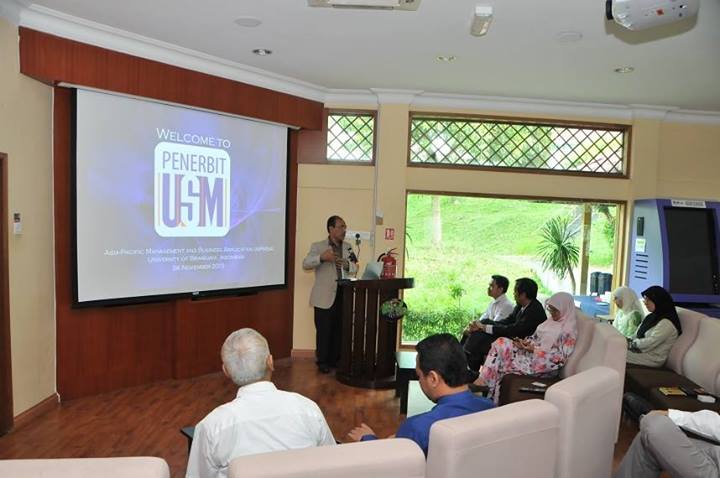 On 26 November 2013, University Sains Malaysia Press (USM Press), the publisher of International Journal of Asia Pacific Studies (IJAPS) was delighted to welcome representatives from the Asia Pacific Management and Business Application (APMBA), University of Brawijaya, Indonesia.
Two officials from APMBA—Dr. Dodi Irawanto, the Editor-in-Chief and Prof. Moeljadi P.S., a member of the Editorial Board—came for this visit. The Director of USM Press, Akhiar Salleh, Editor-in-Chief of IJAPS, Prof. Ooi Keat Gin, Head of Journal Division, Fazlina Mohamed Rouse and the Journal Division team members represented USM Press.
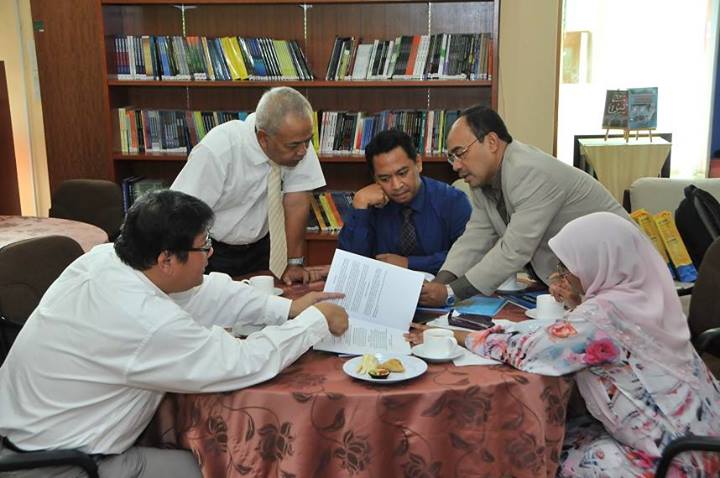
In an enlightening half-day session, both sides had been able to share experience in key aspects of journal operations that include the management structure, milestones, challenges, as well as processes and workflows.
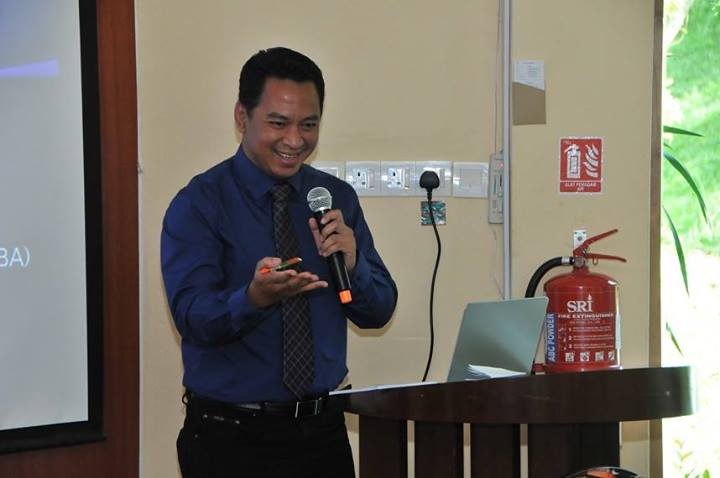
We thank both of our esteemed visitors from APMBA, and we look forward to forming a long-term relationship with the University of Brawijaya.